
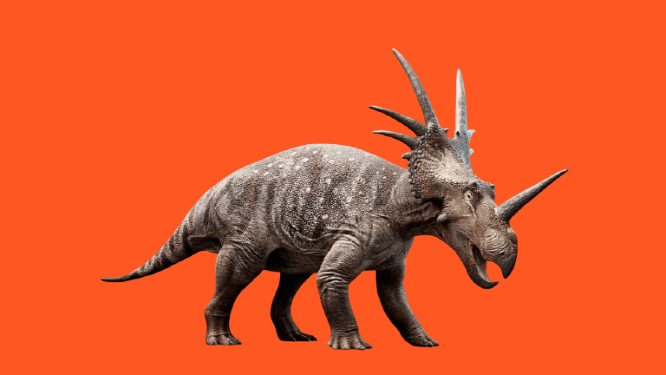
Could You Outrun a Styracosaurus?
The Styracosaurus was a relatively fast-moving herbivore for its size, with estimates suggesting it could reach speeds of up to 20 mph (32 kph). As a quadrupedal ceratopsian. Unlike many other dinosaurs, its leg structure likely allowed for efficient, rapid movement over short distances. Based on analyses of fossil trackways, some paleontologists have suggested that these creatures were faster than modern-day elephants.
Are You Bigger Than a Styracosaurus?
Styracosaurus was a bulky, herbivorous ceratopsian from the Late Cretaceous, measuring approximately 5 to 6 meters (16 – 20 ft) in length, 1.8 to 2.8 meters (6 -9 ft) tall at the hips, and weighing between 2 and 4 tonnes, which is roughly the size of a modern rhino. This creature featured a massive neck frill with 4–6 long spines and a large nose horn, which could be up to 60 cm (2 ft) long.
Fun Facts
- Styracosaurus means spiked frill
- Styracosaurus possessed cheek pouches to store food
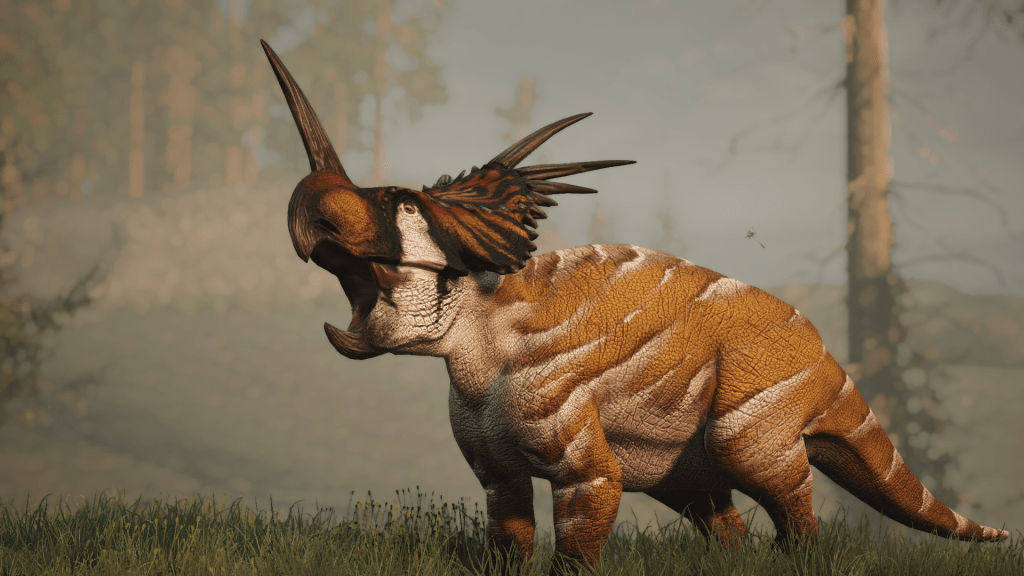
- Unlike other horned dinosaurs, the number, size, and shape of the spikes on a Styracosaurus frill were not uniform across the species. They often changed as the animal aged, with some individuals having asymmetrical, unique “fingerprints” of spikes
- Early reconstructions based on the 1913 discovery erroneously showed a crushed skull, making the frill look like it lay flat, when it actually stood at a much higher, more vertical angle.
- They possessed “dental batteries,” which were continuous rows of shearing teeth that allowed them to slice through tough vegetation like cycads and palms.
Dino-mite Equations!
Question #1: A Styracosaurus can run at a top speed of 20 miles per hour. If a hungry predator chases a Styracosaurus and the chase lasts for 2 hours at that constant speed, how many miles will the Styracosaurus have traveled?
Answer #1
40 miles!
Question #2: A Styracosaurus typically has 6 long spikes on its bony frill. If a small herd of 5 Styracosauruses is grazing together, how many total frill spikes are there in the group?
Answer #2
There are 30 spikes in the herd!
 VelociLogic