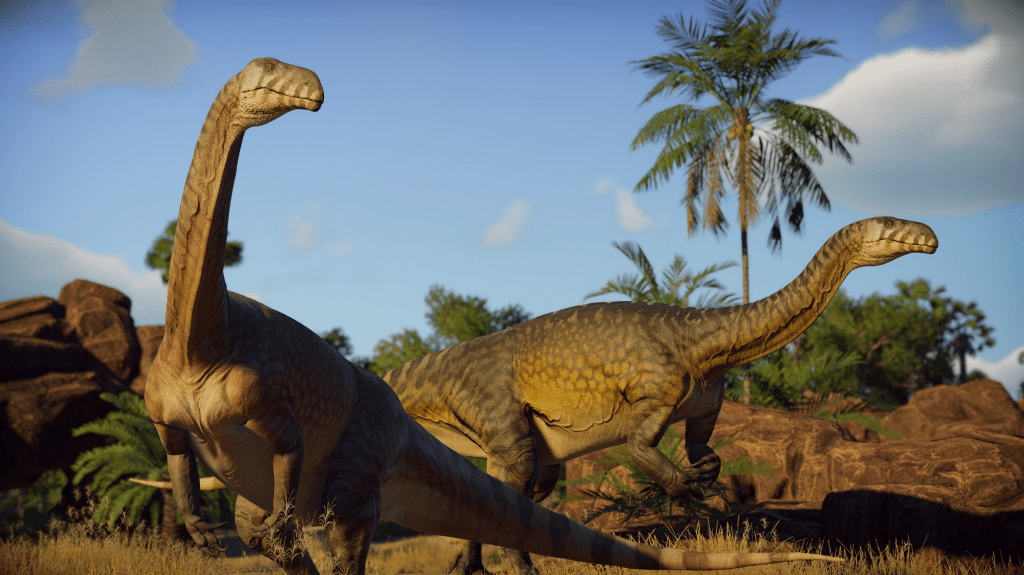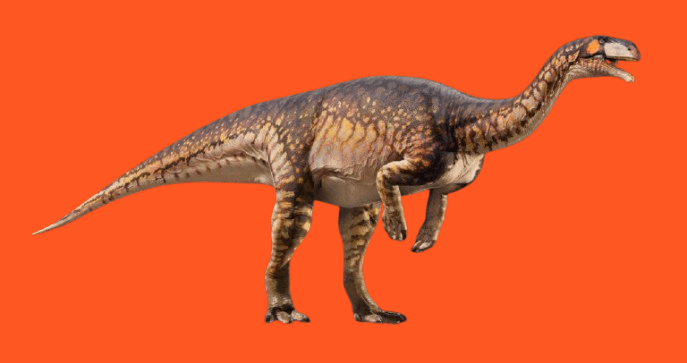
Plateosaurus Description
Plateosaurus was an early, herbivorous dinosaur that roamed Europe and Greenland during the Late Triassic period. Often called a “prosauropod,” it featured a small, narrow skull atop a long, flexible neck. Its body was sturdy, balanced by a long, heavy tail.
Could You Outrun a Plateosaurus?
Probably not, unless you are an elite athlete. Biomechanical models of the Plateosaurus reveal that, despite its bulky appearance, its leg structure was built to cover ground surprisingly quickly. This prehistoric herbivore walked and ran strictly as a biped, meaning it moved on two legs. While it lacked an airborne “spring” phase during movement, it gained immense speed through high-frequency leg retraction, reaching an estimated top speed of 20 mph (33 km/h). Because it easily outpaces the average human running speed of 8 to 12 mph, only Olympic-level sprinters could hope to tie or outrun it.
Are You Bigger Than a Plateosaurus?
You are significantly smaller than an adult Plateosaurus. Adult Plateosaurus giants completely dwarfed humans. Their sizes varied dramatically due to unique developmental plasticity. Fully grown adults stretched 16 to 33 feet (5 to 10 meters) long. They stood roughly 10 feet (3 meters) tall. They weighed between 1,300 and 8,800 pounds (600 to 4,000 kg). Even a baby Plateosaurus measured 7.5 feet long. A human is only a tiny fraction of their massive size.
Fun Facts
- Nicknamed the “Swabian Lindworm” in Germany.
- Discovered before the word “dinosaur” existed.
- Equipped with massive, sharp thumb claws.
- Sideways-pointing eyes granted all-around vision.
- Had highly efficient, bird-like respiratory systems.
Dino-mite Equations!
Question #1: If an adult Plateosaurus sprints at its maximum speed of 20 mph (33 km/h), how many miles will it cover in 15 minutes?
Answer #1
5 miles!
Question #2: If a large, fully grown Plateosaurus weighs 6,000 pounds (2,722 kg) and the average human weighs 150 pounds, how many humans would it take to equal the weight of just one Plateosaurus?
Answer #2
40 humans!