
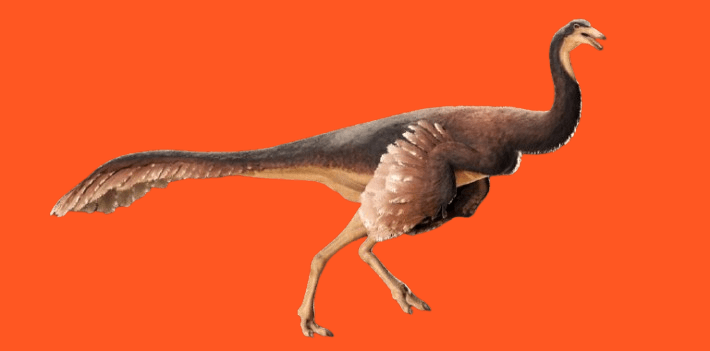
Gallimimus Description
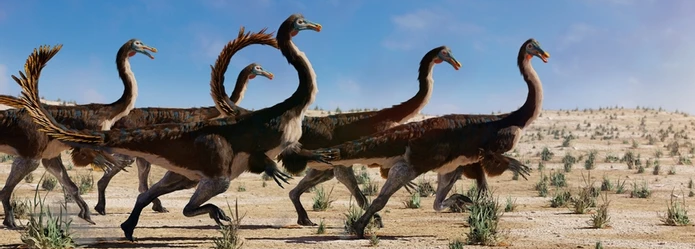
Gallimimus (“chicken mimic”) was a large, fast-moving, ostrich-like theropod from Late Cretaceous Mongolia, often found in flocks. It had a small head, large eyes, a long, toothless, keratinous beak, a long neck, and a long, stiff tail for balance. It was likely feathered, omnivorous, and utilized high-speed running to avoid predators.
Could You Outrun a Gallimimus?
Gallimimus, a Late Cretaceous ornithomimid, was one of the fastest dinosaurs, capable of reaching estimated top speeds between 30 and 50 miles per hour (48-80 km/h), often compared to modern ostriches due to its exceptionally long legs and lightweight build. As the largest “chicken mimic,” this theropod boasted specialized leg adaptations, including a shorter thigh bone and elongated metatarsals designed for sprinting, making it faster than most, if not all, of its predators. Because it possessed a small, toothless, and lightweight head with a delicate beak, its bite force was remarkably low, designed for an omnivorous diet of small animals, insects, eggs, and plants rather than combat. Instead of relying on a powerful bite, Gallimimus utilized speed and agility for survival, likely travelling in flocks for protection, with some evidence suggesting it could apply protective, high-speed movement mechanisms.
Are You Bigger Than a Gallimimus?
Gallimimus was the largest known ornithomimid (“bird-mimic”) dinosaur, with adults typically measuring roughly 6 meters (20 ft) in length and standing about 1.9 to 2 meters (6.3–6.5 ft) tall at the hip. Weighing approximately 400–490 kilograms (880–1,080 lb), this bipedal dinosaur was designed for speed, featuring a slender, ostrich-like body with long hindlimbs and a long neck. It had a small, toothless, beaked head with large, laterally placed eyes and a long tail to provide balance.
Fun Facts
- While they were quick-running, their arms and hands were the shortest in proportion to their body of any ornithomimosaur, and their three-fingered hands were relatively stiff and inflexible.
- Despite having large eyes, they were positioned on the sides of the head, giving them excellent peripheral vision for spotting predators but very poor depth perception.
- It has been suggested that the small ridges inside their toothless beaks were used for filter-feeding in water, similar to modern ducks, though they may have also been used for eating tough plants.
- To achieve its high speeds, Gallimimus had pneumatic (air-filled) bones, meaning its skeletal structure was very light yet strong.
- Its name comes from its neck vertebrae, which strangely resemble those of modern chickens, rather than just its overall bird-like appearance.
Dino-mite Equations!
Question #1: An adult Gallimimus has a maximum running speed of approximately 49.7 km/h. A third of this speed would be:
Answer #1
16.57 km/h!
Question #2: How heavy would 92 Gallimimus be?
Answer #2
45080 kg!
 VelociLogic