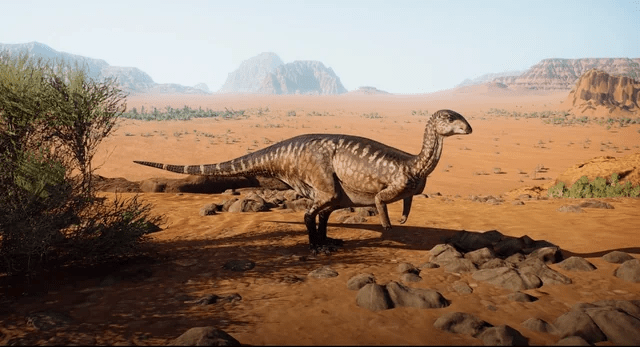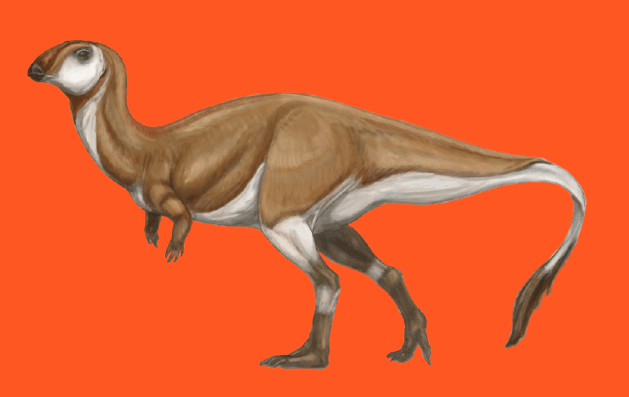
Dryosaurus Description
Dryosaurus was an agile, fast-running, bipedal herbivore that lived during the Late Jurassic period, roughly (155) to (140) million years ago. Recognized for its slender legs, stiffened tail for balance, and large eyes, it relied on speed and communal herding to evade predators.
Could You Outrun a Dryosaurus?
Dryosaurus was a Late Jurassic herbivore celebrated for its remarkable speed and agility. Paleontologists estimate that it could reach top sprinting speeds of roughly 40 50 km. This bursts-of-speed capability was its primary—and often only—defense mechanism against contemporary apex predators like Allosaurus and Ceratosaurus. To achieve such impressive velocities, it possessed a lightweight, bipedal frame featuring unusually long, slender hindlimbs and a stiffened, ossified tail that acted as an aerodynamic counterbalance during high-speed twists, turns, and abrupt direction changes. Coupled with large eyes for excellent coordination and quick stamina recovery in dense environments, this specialized anatomy allowed the “tree lizard” to easily evade threats. You can read more about its ecology and adaptations on Wikipedia or Fossilicious.
Are You Bigger Than a Dryosaurus?
The Dryosaurus was an agile, Late Jurassic ornithopod that measured roughly 8 to 14 feet (2.4 to 4.3 meters) in length and weighed between 150 and 200 pounds (70 to 90 kilograms). It stood about 5 feet tall at the hips. However, fully grown adult fossils have never been found, so its true maximum size remains unknown.
Fun Facts
- Its name translates to “oak lizard” because its teeth resemble the shape of an oak tree leaf.
- It possessed a stiff, horny beak for cropping leaves and enlarged cheek pouches to store partially chewed vegetation while foraging.
- Paleontologists know it had very large eye sockets, suggesting it relied heavily on sharp vision to spot danger quickly.
- Unlike many other ornithopods, it kept primitive five-fingered hands, even though it walked entirely on its two robust back legs.
- At the famous Carnegie Quarry in Dinosaur National Monument, Utah, it is classified as the smallest adult dinosaur found.
Dino-mite Equations!
Question #1: If a Dryosaurus runs at its top speed of 50 km/h and a human sprints at 33.43 km/h, how much faster is the Dryosaurus in km/h?
Answer #1
16.57 km/h!
Question #2: A migration herd consists of 644 Dryosaurus dinosaurs. If each individual weighs the minimum estimated weight of 70 kg, what is the total weight of the herd in kilograms?
Answer #2
45080 kg!