
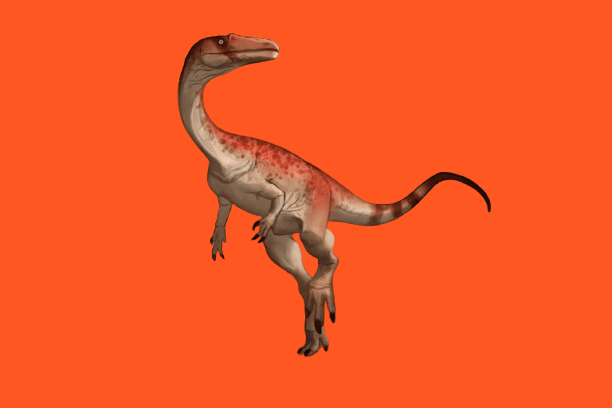
Coelophysis Description
Coelophysis was a small, nimble, bird-like carnivorous dinosaur that lived during the Late Triassic period. Famous for its hollow bones—which give it its name—this ancient predator was built for agility and speed, sporting a slender body, long neck, and pointed tail.
Could You Outrun a Coelophysis?
No, you likely could not outrun a Coelophysis. This lightweight Triassic predator was built for extreme speed. Scientists estimate its top running speed at 25 to 30 mph. That is roughly 40 to 48 km/h. An average human runs around 12 to 15 mph. Only elite sprinters can match its maximum pace.
Are You Bigger Than a Coelophysis?
Yes, you are likely heavier than a Coelophysis, but it was much longer than you. An adult Coelophysis grew up to 9.8 feet (3 meters) long from snout to tail. However, it stood only about 3 feet (1 meter) tall at the hip. Thanks to its hollow bones, it weighed a mere 33 to 55 pounds (15 to 25 kg). This means a typical adult human outweighs this slender dinosaur by more than triple its mass, even though the dinosaur stretches far longer than a human is tall.
Fun Facts
- A Coelophysis skull from the Carnegie Museum of Natural History flew aboard the Space Shuttle Endeavour in 1998.
- New Mexico designated Coelophysis as its official state fossil in 1981 to honor the massive discoveries at Ghost Ranch.
- This Triassic predator was one of the earliest known dinosaurs to possess a furcula, just like a modern bird
- Scientists once thought adults ate their babies, but modern scans showed the “stomach bones” were actually small prehistoric crocodiles.
- Its eyes faced directly forward, giving it excellent depth perception to hunt moving target animals.
Dino-mite Equations!
Question #1: If a Coelophysis can run at a top speed of 30 miles per hour, how many miles can it cover in 20 minutes if it maintains that maximum pace?
Answer #1
10 miles!
Question #2: An average adult Coelophysis weighs about 45 pounds. If a person weighs 180 pounds, how many Coelophysis dinosaurs would it take to equal the weight of that one human?
Answer #2
4!

 VelociLogic