
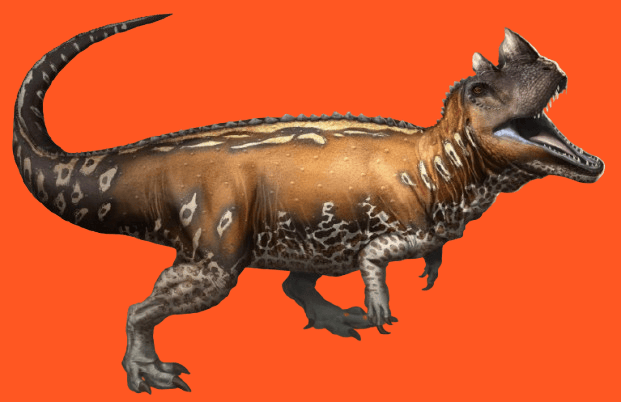
Ceratosaurus Description
Ceratosaurus was a striking and highly distinctive predatory dinosaur that stalked the floodplains of North America, Europe, and Africa during the Late Jurassic period. Characterized by its deep, powerful skull, this theropod’s most defining feature was the prominent, blade-like horn sitting atop its snout, which was accompanied by smaller, ridge-like crests above its eyes. Unlike many other large carnivores of its era, its jaws were armed with exceptionally long, blade-like teeth that actually protruded past its lower jaw line when its mouth was closed, giving it a menacing appearance. Another unique feature was the row of small, bony plates called osteoderms running down the center of its neck, back, and tail, a form of armor rarely seen in theropod dinosaurs. Its body was robustly built, supported by powerful hind limbs, while its four-fingered forelimbs—though relatively short—remained fully functional and retained claws for grasping prey. Its flexible, deep tail suggests it was an agile hunter, well-equipped to navigate dense vegetation and river systems where it likely competed with other formidable predators of its time.
Could You Outrun a Ceratosaurus?
Probably not! Scientists estimate that Ceratosaurus could reach top running speeds of around 30 to 40 kilometers per hour (19 to 25 miles per hour). In comparison, the average human runs at a speed of about 10 to 13 km/h (6 to 8 mph), and even Olympic sprinters top out near 44 km/h (27 mph) for only very short bursts. Unless you are a world-class athlete with a massive head start, this agile Jurassic predator would easily catch up to you.
Are You Bigger Than a Ceratosaurus?
Not even close! An adult Ceratosaurus was a formidable mid-sized predator, stretching roughly 6 to 7 meters (20 to 23 feet) in length and standing about 2.5 meters (8 feet) tall at the hips. Weighing in at approximately 980 kilograms (nearly 2,200 pounds), it was heavier than a modern-day grizzly bear or a small car. Even the tallest humans would only reach up to its hip joint, making you look like a small snack next to this Jurassic carnivore.
Fun Facts
- Ceratosaurus is famous for the prominent, blade-like horn on its snout, giving it the name “horned lizard”.
- Unlike most theropods that had three fingers, Ceratosaurus uniquely retained a fourth clawed finger on each hand.
- It is one of the very few carnivorous dinosaurs known to have had rows of osteoderms (bony skin armor) running down its neck, back, and tail.
- Its upper jaw housed unusually long, knife-like teeth relative to its skull size, specialized for a “bite and back away” attack strategy.
- Its muscular, deep, and flexible tail suggests it may have been an agile swimmer capable of hunting aquatic prey like crocodiles and fish.
Dino-mite Equations!
Question #1: An adult Ceratosaurus grows up to an average length of 7 meters. If a juvenile Ceratosaurus is currently 3.2 meters long, write and solve an equation to find how many more meters (m) it needs to grow to reach its adult size.
Answer #1
3.8 meters!
Question #2: A full-grown Ceratosaurus weighs approximately 980 kilograms. If it needs to consume exactly 4% of its body weight in meat every week to stay healthy, write and solve an algebraic equation to find the total kilograms of meat (m) it must eat
Answer #2
39.2 kg!
 VelociLogic