
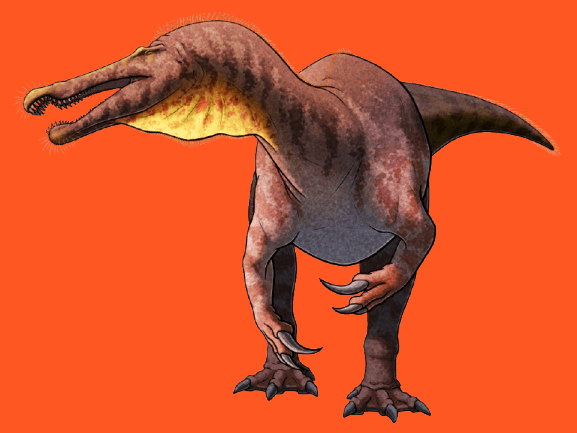
Baryonyx Description
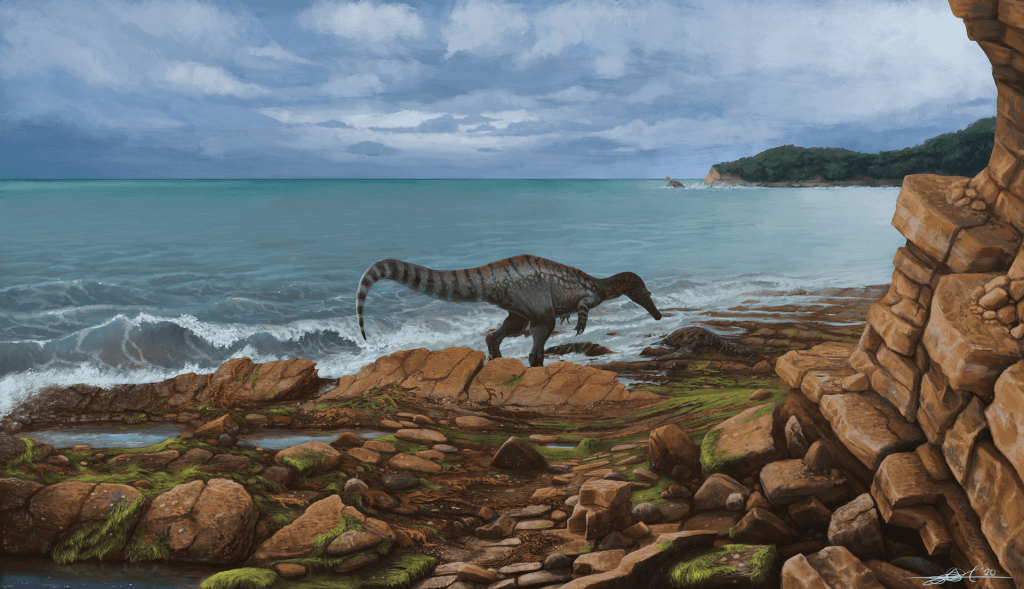
Baryonyx was a large, fish-eating theropod dinosaur from the Early Cretaceous period (about 130-125 million years ago) in Europe, known for its crocodile-like long, narrow snout, numerous fine teeth, and a huge, hooked claw on its thumb, suggesting a semi-aquatic lifestyle, hunting fish in rivers and swamps, much like a grizzly bear, but with dinosaur features. Baryonyx was a specialized, large predatory dinosaur uniquely equipped for a life near or in water, differing significantly from typical meat-eating dinosaurs like T. rex.
Could You Outrun a Baryonyx?
In all likelihood, a human could not outrun a Baryonyx. The Baryonyx, a bipedal theropod, was a formidable predator built for speed, capable of reaching a top speed of approximately 39.8 km/h (about 24.8 mph). An average, healthy adult human can run at a top speed of around 15 mph, a speed many of us might struggle to maintain for long. Baryonyx likely had the physiology to maintain a high speed for a significant amount of time, potentially upwards of 10 minutes. This means that in a short sprint, or over a moderate distance, a human would be quickly overtaken.
Are You Bigger Than a Baryonyx?
The typical Baryonyx specimen measured approximately 25 to 33 feet (7.5 to 10 meters) in length and stood about 10 feet (3 meters) tall at the hips. Its weight is estimated to have been between 1.2 and 2 metric tons, or 2,600 to 4,400 pounds. The primary fossil specimen found was not even fully grown, meaning an adult individual could potentially have been even larger. In terms of scale, a human would be dwarfed by the sheer size and mass of this fish-eating predator, which hunted large prey with its bite force of around 3,500 newtons.
Fun Facts
- Baryonyx had more teeth than T. rex
- Baryonyx means heavy claw.
- It had a possibly mixed diet
- Baryonyx belongs to the Spinosauridae family
- One of the first dinosaurs to be discovered as a fish-eater
Dino-mite Equations!
Question #1: How fast would 4 less than 7 Baryonyx be?
Answer #1
74.4 mph!
Question #2: What would half of a maximum-weight Baryonyx weigh?
Answer #2
2,200 lbs!
 VelociLogic